Why AI Is Not an IT Project
AI changes more than your systems. It changes how value is created. Many organizations treat AI as an implementation project. But when you address these questions at management level, you gain different insight and discover how to truly deploy AI.
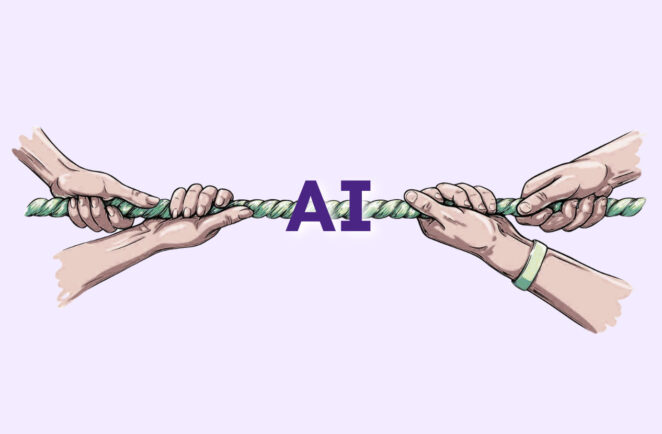
In many staffing and recruitment organisations, AI still lands on the desk of IT or operations, where it gets the same treatment as every other system that has ever been rolled out: a tool gets tested, a pilot gets run, a dashboard gets purchased, with a project owner and an implementation timeline, until it can finally be ticked off in the annual plan as “live.”
That’s exactly why so many AI initiatives in this sector end up amounting to so little. The approach simply sells AI short, because it misses what’s actually happening: AI changes how a business creates value, where people spend their time, how clients and candidates are served, and where tomorrow’s competitive advantage comes from. That makes it a question for the leadership team, not an implementation project for IT.
The question that actually matters
Anyone who treats AI mainly as a technical project ends up looking for a solution within the boundaries of what already exists: something that makes a task faster or cheaper, without changing anything about how the business actually works. That’s a narrow way of looking at it, because the impact of AI doesn’t stop at that one task. It touches on what clients will expect from a staffing partner going forward, how consultants spend their time, and which firms still play a relevant role in the market a few years from now.
That kind of optimisation feels like progress: a process that runs a bit faster, a few hours saved each week, a little less manual work. Comfortable, measurable, and easy to sell to a leadership team that wants to see results. But optimising within a model that will have lost its value in a few years mainly buys time. At that point, optimising isn’t a strategy, it’s a way of postponing the question that actually needs an answer.
Why this belongs with leadership
This subject touches on three things that go beyond what an IT department or a single operational team can decide.
The business model. When AI takes over part of the transactional work, such as intake, matching and administration, the value clients are paying for shifts too. They start paying less for speed of execution and more for the judgement, advice and network of the people doing the work. That shift often calls for different positioning, different pricing, and sometimes a different revenue model, and those are decisions that sit with leadership.
Culture and role division. Consultants and recruiters who currently spend a lot of time on process management gradually move into a role centred on relationships and decisions. That shift calls for new expectations, different ways of evaluating people, and sometimes different people altogether, and no implementation manual has a grip on that.
Risk and trust. Someone has to decide what AI is and isn’t allowed to do autonomously towards clients and candidates, and who’s accountable when it goes wrong. In a trust-based industry, compliance and control aren’t a side note, they’re the condition for being allowed to use AI at all, and that responsibility sits with the board.
So how do you actually approach it?
When AI is treated as an organisational question rather than a tool, the conversation starts with a set of questions that need answering at leadership level:
- Where are people losing time and value today, in admin, systems and repetition, when they should be making the difference instead?
- Which part of the work needs to stay human, and how is everything else built around that?
- Is the foundation of data and processes solid, because AI is never better than the base it runs on?
- What comes first on the roadmap, prioritised by impact rather than by what happens to be available?
- Is the organisation starting small, with room to learn before scaling up?
Adoption deserves just as much attention as the strategy itself. Most AI implementations that fail don’t fail because of the technology, they fail because people don’t use it, don’t trust it, or don’t understand why it’s there.
The most successful organisations in staffing and recruitment won't necessarily be the ones with the most advanced AI tools. They'll be the ones where management worked through these questions themselves, instead of leaving them to IT.
The bottom line
The organisations leading staffing and recruitment a few years from now won’t necessarily be the ones with the most advanced AI tools. They’ll be the ones where leadership worked through these questions themselves, instead of leaving them to IT. They apply AI deliberately, to the parts of the process where it genuinely adds value, so their people can do their best work. Everyone else keeps optimising, calls it progress, until it’s too late to do anything else.
In the end, it comes down to a choice: keep optimising within today’s model, or take the time to decide what tomorrow’s model looks like.
Curious how this looks in practice? Download the whitepaper “Are you optimising, or are you innovating?” for a practical look at where and how to put AI to work in your organisation.