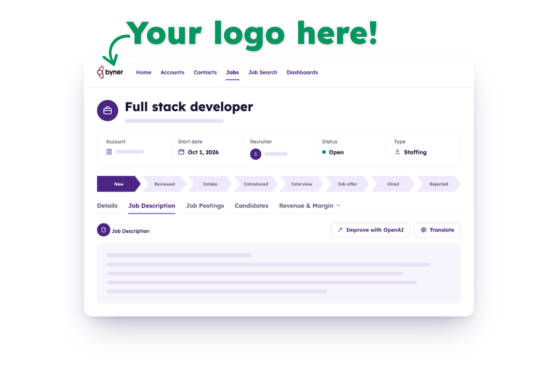
Byner is going agentic and it starts with recruitment
Byner is an end-to-end platform for staffing and recruitment agencies, built natively on Salesforce, covering everything from sourcing and placement to scheduling, time tracking and invoicing. With release 4.6, we’ve shipped something new: the first real Byner agents. Here’s what that means, and why we think it matters for the staffing industry as a whole.

Byner goes agentic
For more than two years, Byner’s AI Assistant has helped recruiters draft emails, review CVs, and generate content – on request, one action at a time. With our latest release 4.6, we’re going a real step further: we introduce the first Byner agents, capable of carrying out entire steps of the recruitment process on their own, not just supporting a single action when asked.
That’s a meaningful difference. An assistant waits to be used. An agent recognises that a moment in the process has been reached and acts on it, while staying fully reviewable, with the recruiter in control of what happens next. A few of the agents shipping in 4.6:
- One agent drafts interview guidelines the moment a job is created or an interview is scheduled, so the recruiter walks in prepared without writing them first.
- One agent gets the notes of an intake call with a client and updates the resulting job description, so the recruiter doesn’t have to copy the details by hand.
- One agent gets the notes of an interview with a candidate and updates the candidate’s profile from what came up in conversation.
- One agent assembles a tailor-made CV, pulling in more context automatically and cutting down the editing needed before the candidate is introduced to a client.
- One agent carries out routine workflow steps, for example a rejection or a reminder, the moment a candidate reaches a defined stage, instead of waiting for a recruiter to start it manually.
In every case, the recruiter reviews what the agent produced and decides whether to send it on, adjust it, or override it. The agent does the work; the person keeps the decision.
Our broader vision: automating how staffing businesses operate
We’re putting this first wave of agents to work on recruitment specifically, because that’s where we see the most to gain right now: a lot of a recruiter’s day still consists of work that’s manual and administrative, even though most of it follows a repeatable pattern.
Our vision for this is much broader than just a chat interface: We want a recruitment process where agents and recruiters work alongside each other continuously to make work faster and better. Imagine an incoming request routed to the right person, an intake call prepared automatically, candidates sourced and screened for the recruiter to review, interviews prepped or a customer presentation drafted in seconds. All of that happens with agents handling the operational steps in the background, and recruiters stepping in exactly where a person is needed: running the intake call, conducting the candidate interview, deciding who moves forward, making the final match. This is our eng goal and we keep building toward that picture release by release.
This improves efficiency greatly, but it doesn’t stop there. When agents take over the preparation and admin work, recruiters have more time to actually understand a role and a candidate in depth, instead of rushing through it. We expect that to show up as better, not just faster matching: recruiters who can advise their clients with more confidence on who the right person is, will land more and better placements, and ultimately create more revenue for the staffing firm.
Recruitment is where we’re starting, not where we stop. The same thinking applies everywhere else in a staffing business: sales teams manage a pipeline full of manual follow-up and reporting and operations teams handle resource requests and administrative work that follows its own patterns. Once agentic AI is proven in recruitment, we’ll bring it to the other parts of the business as well.
From recruiter to consultant
A large part of a recruiter’s day today has little to do with recruiting itself: chasing information across disconnected tools, preparing documents by hand, re-entering data that already exists somewhere else, keeping track of who needs a follow-up and when. That’s the operator side of the job. It is necessary, but it pulls attention away from the part of the work that actually matters: the people and the advice a good staffing partner gives.
As agents take over that operational layer, the job shifts with it: from recruiter to consultant. Less time spent sourcing, screening, and pushing paperwork through the process; more time spent on what genuinely needs a person: building trust with a client, understanding what a candidate is really looking for, understanding an interview well, advising on who’s the right fit and why. This is where the real human factor comes in: deciding when to run with an agent’s output and when to overrule it, always staying accountable for what goes out and who gets placed.
One thing that is especially important to us: This isn’t about replacing anyone. Byner’s agents don’t make placements, they don’t decide who’s rejected, and don’t run the actual conversations. They handle the operational work that needs to be done to make the decision. The result is a consultant who enters every conversation better prepared, with the admin work already done, and more time for the relationships and judgment calls that were always the real job.
The bigger picture
We think this matters beyond Byner. Software itself is shifting from something people operate to something that acts alongside them. At the same time, staffing firms are under real pressure of their own. Client expectations are rising, margins are tightening, and regulations (like equal pay, the EU AI Act, WTTA) increasingly have to be built into daily operations. These two shifts are reinforcing each other, and together they’re changing what a staffing firm’s operating model needs to look like.
We don’t see this as a five-year horizon. Staffing firms that start automating this now will be operating very differently twelve to eighteen months from now and have a competitive advantage over those who wait. 4.6 is Byner’s first step in that direction. More agents, and more of the process, follow from here.
Discover how you can take your business to the next level